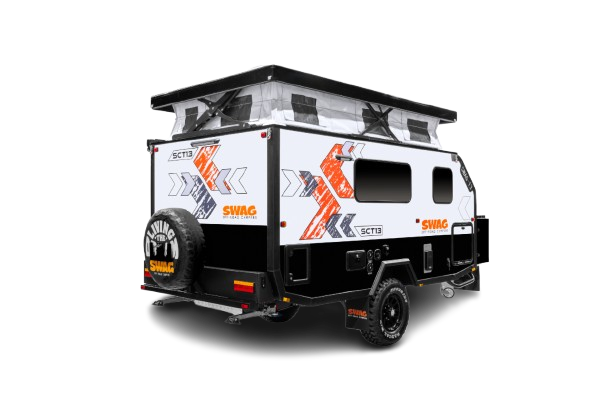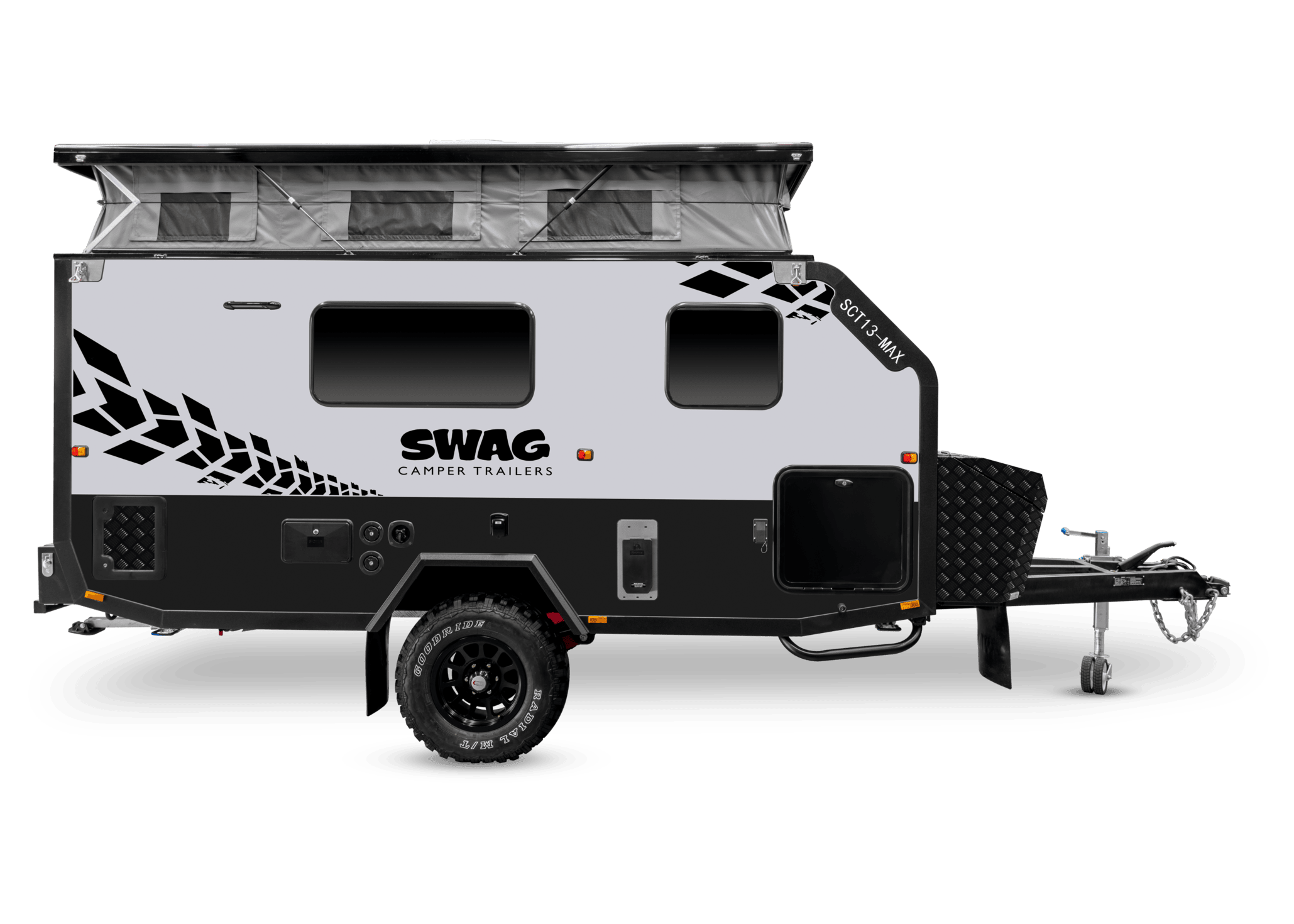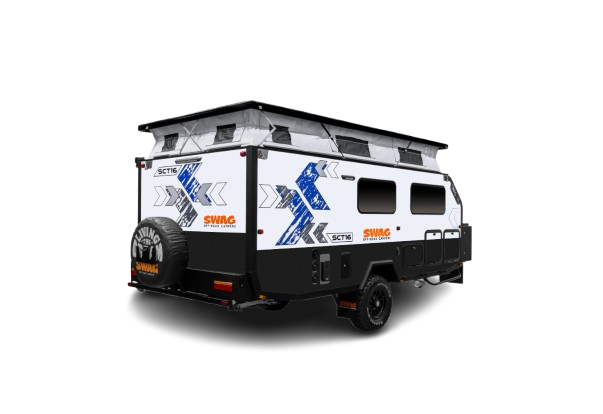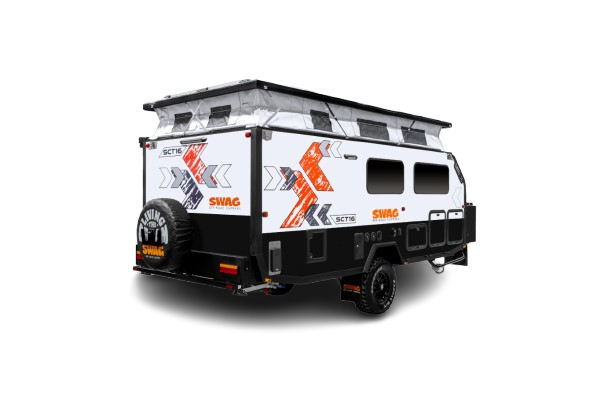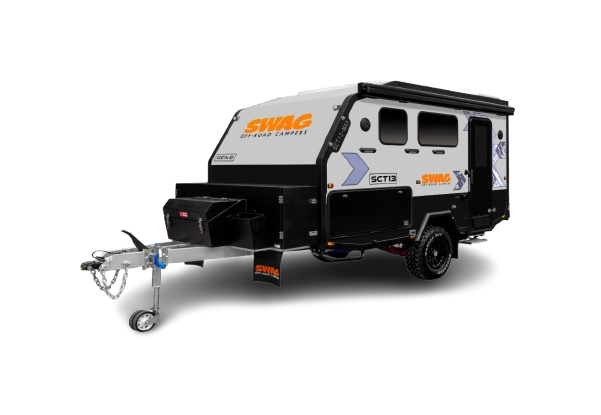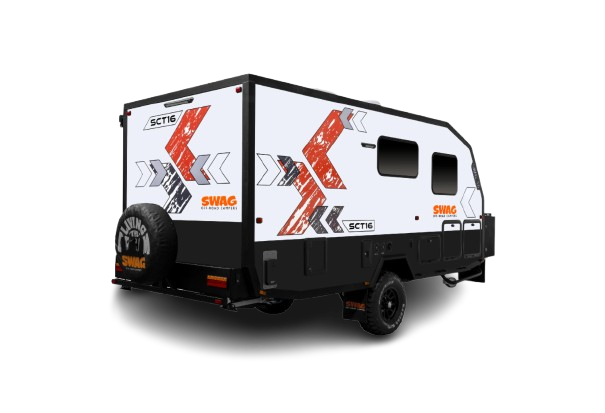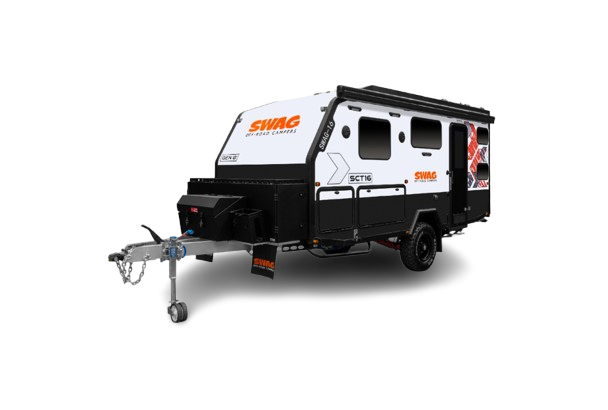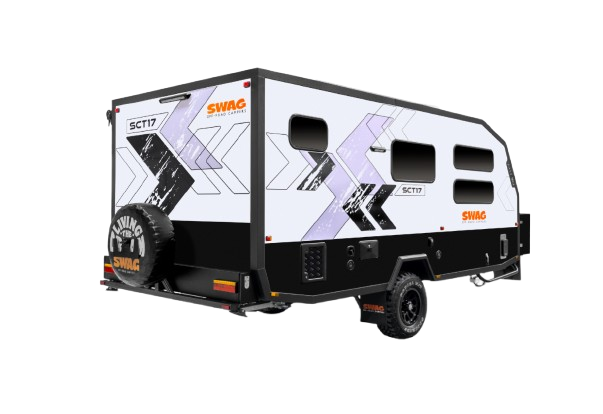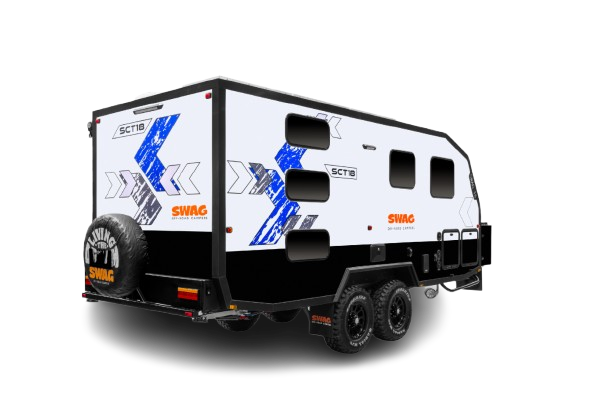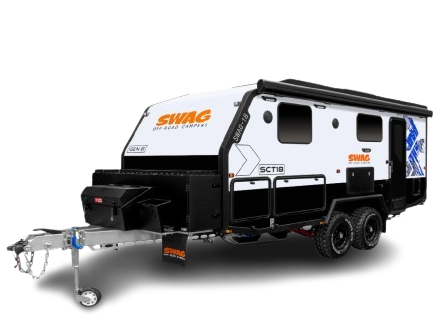
The best caravan for touring Australia should make long-term travel easier, not just give you somewhere to sleep.
For couples planning the Big Lap or spending months at a time on the road, our first recommendation is the SWAG SCT17. Its lighter single-axle setup, larger internal fridge, washing machine, queen island bed and spacious caravan-width body make it particularly well suited to extended touring where day-to-day comfort matters.
For travellers who want to spend more time off the beaten track, the SCT18 Couples offers a narrower hybrid body, dual-axle setup, more external storage and an external fridge. That narrower footprint also follows the tow vehicle’s tyre tracks more closely, which can make it easier to pull through sand and tighter off-road conditions.
Families can choose between the SCT18 Family 4-Berth and 5-Berth, giving four or five travellers permanent sleeping spaces while retaining the SCT18’s narrower off-road hybrid design.
For couples planning to spend months travelling around Australia, the SCT17 is our first choice.
It is built around the type of features that become more valuable the longer you stay on the road. You get a large internal fridge, a washing machine, internal cooking facilities, a full ensuite and a queen island bed that can be accessed from both sides.
That island-bed layout is a particularly useful touring feature. Both travellers can get in and out without climbing over one another, while making the bed is much easier than with layouts pushed tightly against the walls.
The SCT17 also gives you:
For someone spending a few weeks away, a washing machine or larger fridge might sound like a luxury. When you are travelling for three, six or twelve months, they can change how often you need to stop in major towns and how comfortable everyday life feels.
The SCT17 is also approximately 300kg lighter than the SCT18 and runs on a single axle, making it a more manageable option for many touring couples.
It still uses the same off-road suspension underneath as the rest of the SWAG range. We classify it as a semi off-road caravan because the SCT17 has been designed more like a traditional caravan for long-term touring, with a wider body, large internal fridge and washing machine.
At around 200mm wider than the rest of the SWAG hybrid range, that extra width creates more usable living space inside the van. The trade-off is that it does not track directly behind the tow vehicle as closely as the narrower SCT18, which becomes more relevant on sand and tighter off-road tracks.
For couples planning the Big Lap, the SCT17 is our strongest all-round recommendation because it puts long-term liveability first without giving up the suspension, power and water capacity needed for serious Australian touring.
The SCT18 Couples is our recommendation for travellers who want to push further beyond the highway and established caravan routes.
One of the biggest differences is width.
The SCT18 is around 200mm narrower than the SCT17 and has more of a true off-road hybrid footprint. Its wheels follow more closely in the same tyre tracks as the tow vehicle, which can make a noticeable difference when towing through sand or travelling along narrow tracks.
It also runs a dual-axle setup, compared with the SCT17’s single axle, and provides more external storage for travellers carrying camping gear, tools and equipment.
Where the SCT17 focuses heavily on internal touring comfort, the SCT18 shifts more of the functionality outside. It includes an external fridge and greater external storage capacity, giving travellers easy access to food, drinks and equipment without needing to head inside the caravan.
The SCT18 also includes:
Its 600W solar setup also gives it an advantage for travellers planning longer stays away from powered sites.
The king-size bed gives the SCT18 a more spacious sleeping setup than the SCT17, while the additional external storage makes it easier to organise gear that you do not necessarily want taking up space inside the van.
Choose the SCT18 Couples if your Big Lap will involve more beach driving, sand, off-road tracks and remote camping. Choose the SCT17 if you expect to spend more time living inside the van and prioritise long-term comfort.
For most couples planning a traditional Big Lap, we recommend the SCT17 first.
Its wider body, large internal fridge, washing machine, island bed and lower weight make it particularly well suited to months of continuous touring.
The SCT18 becomes the better option when off-road access and external storage move higher up your priority list.
| Feature | SCT17 | SCT18 Couples |
|---|---|---|
| Best suited to | Long-term touring | Off-road and remote touring |
| Axles | Single axle | Dual axle |
| Weight | Approx. 300kg lighter | Approx. 300kg heavier |
| Body width | Approx. 200mm wider | Narrower hybrid body |
| Bed | Queen island bed | King bed |
| Fridge | Large internal fridge | External fridge + smaller internal fridge |
| Washing machine | Yes | No standard washing machine |
| Internal cooking | Yes | More outdoor-focused |
| External storage | Good | More extensive |
| Solar | 400W | 600W |
| Suspension | Off-road suspension | Off-road suspension |
| Sand towing | Wider track | Better aligned with tow vehicle tracks |
The decision largely comes down to how you expect to use the van.
If you are travelling highway kilometres, staying for weeks at a time in different regions and effectively living from the caravan for months, the SCT17 has the edge.
If you are deliberately chasing remote camps, beaches and more difficult access tracks, the narrower SCT18 layout becomes a major advantage.
For families of four taking on the Big Lap, the SCT18 Family 4-Berth combines permanent sleeping spaces with the narrower off-road hybrid platform found across the SCT18 range.
Parents get a king-size bed, while the kids have two permanent 2m-long bunks. There is no need to turn the dining area into a bed every night or pack bedding away each morning.
Those full-length bunks also make the van more practical as children grow. Families can invest in a caravan they can continue using as younger kids become teenagers.
The 4-berth includes:
The narrower SCT18 body is also an advantage for families who want to reach campsites beyond the standard caravan park network.
For a family of four, the SCT18 4-berth gives everyone a permanent bed while retaining the water, power and off-road capability needed for extended travel around Australia.
Families of five often face a difficult choice when shopping for a touring caravan: move into a much larger van or accept a layout where someone sleeps on a converted dining area.
The SCT18 Family 5-berth avoids that compromise.
It fits a king-size parents’ bed and three permanent 2m bunks, giving every family member their own sleeping space.
That makes a big difference when you are living in the caravan for months. Beds can stay made, the dining area stays usable, and each child has their own dedicated space.
The 5-berth retains the main touring features of the SCT18 range, including:
Like the 4-berth, it retains the narrower hybrid body that helps the van follow the tow vehicle’s tracks more closely in sand and tighter off-road conditions.
For families of five doing the Big Lap, the SCT18 5-berth is a triple bunk caravan that provides dedicated sleeping space for everyone without forcing you into a substantially larger traditional caravan.
Planning the Big Lap is exciting, but choosing the right caravan can take some thought. The SCT17 and SCT18 each suit a different way of travelling, and the best option comes down to who is coming with you, what you are towing with and where you want the trip to take you.
Contact the SWAG team or visit our Brisbane, Coffs Harbour or Bendigo showrooms and we’ll help you compare the options, walk through the layouts and find the van that feels right for your trip.
Queensland caravan shows give you the chance to inspect dozens of caravans, compare layouts and speak directly with the people behind each brand.
They also vary more than many buyers realise.
Some are major caravan events with hundreds of recreational vehicles on display.
Others bring caravans together with 4WDs, boats, camping gear, home products and general outdoor equipment.
Before driving several hours or booking accommodation, it pays to know exactly what type of event you are attending.
Below, you will find upcoming Queensland caravan show dates, advice on choosing the right event and the practical tips our team recommends once you walk through the gates.
Event information last updated 16 July 2026. Dates, exhibitors, opening hours and entry conditions can change. Always check the organiser’s latest information before travelling.
The calendar below includes caravan-focused events and broader outdoor expos featuring caravans across Queensland. Some events have already taken place, while others are still upcoming.
Check the organiser’s website before travelling, as dates, venues, exhibitors and entry conditions may change.
| Dates | Event | Location | Event Type |
|---|---|---|---|
| 6–8 February 2026 | Let’s Go Gold Coast Caravan & Outdoor Expo | People First Stadium, Carrara | Caravan and outdoor expo |
| 13–15 February 2026 | Moreton Bay Expo | Redcliffe Showgrounds | Caravan, boating, 4WD and outdoor expo |
| 13–15 March 2026 | National 4×4 Outdoors Show Brisbane | Brisbane Showgrounds | 4WD and outdoor show featuring caravans |
| 17–19 April 2026 | Suncoast Outdoor Adventure Expo | Nambour Showgrounds | Caravan, 4WD and outdoor adventure expo |
| 8–10 May 2026 | Cairns Outdoor Adventure plus Home & Lifestyle Expo | Cairns Showgrounds | Caravan, outdoor and lifestyle expo |
| 15–17 May 2026 | Townsville Caravan, 4×4 & Outdoor Adventure Expo | Reid Park, Townsville | Caravan, 4WD and outdoor adventure expo |
| 22–24 May 2026 | Mackay Outdoor Adventure plus Home & Lifestyle Expo | Mackay Showgrounds | Caravan, outdoor and lifestyle expo |
| 3–7 June 2026 | Let’s Go Queensland Caravan & Camping Supershow | Brisbane Showgrounds | Major caravan and camping show |
| 10–12 July 2026 | Rockhampton Outdoor Adventure plus Home & Lifestyle Expo | Rockhampton Showgrounds | Caravan, outdoor and lifestyle expo |
| 17–19 July 2026 | Fraser Coast Outdoor Adventure plus Home & Lifestyle Expo | Maryborough Showgrounds | Caravan, outdoor and lifestyle expo |
| 24–26 July 2026 | Queensland Outdoor Adventure Expo | Toowoomba Showgrounds | Caravan and outdoor adventure expo |
| 15–16 August 2026 | Mackay Big Boys Toys Expo | Mackay Showgrounds | Motoring and outdoor event featuring caravans |
| 21–23 August 2026 | Let’s Go Sunshine Coast Caravan & Outdoor Expo | Nambour Showgrounds | Caravan-focused event |
| 28–30 August 2026 | Let’s Go Ipswich Caravan & RV Expo | Willowbank Raceway | Caravan and RV-focused event |
| 5–6 September 2026 | Cairns Big Boys Toys Expo | Cairns Showgrounds | Motoring and outdoor event featuring caravans |
| 18–20 September 2026 | Cleveland Caravan, Camping, Boating & 4×4 Expo | Redland Showgrounds | Caravan, boating and 4WD expo |
| 25–27 September 2026 | Sunshine Coast Expo | Kawana Sports Precinct, Bokarina | Caravan, boating and outdoor expo |
| 16–18 October 2026 | Ipswich Outdoor Living, 4×4 & Caravan Expo | Ipswich Showgrounds | Caravan, camping and 4WD expo |
| 29 October–1 November 2026 | Let’s Go Explore Caravan & RV Expo | Brisbane Showgrounds | Major caravan and RV event |
| 27–29 November 2026 | Caboolture Outdoor Adventure plus Home & Lifestyle Expo | Caboolture Showgrounds | Caravan, outdoor and lifestyle expo |
The closest show is often the most convenient, but it may not be the most useful for what you want to achieve.
Someone looking for an enjoyable family day out may choose differently from a buyer who has narrowed their search to three caravan brands and wants to compare final specifications.
Before choosing an event, work out what you want to get from the day.
The Let’s Go Queensland Caravan & Camping Supershow in Brisbane is the strongest option for buyers who want to compare the broadest range of caravans and RV products.
The event usually features hundreds of exhibitors across caravans, camper trailers, motorhomes, campervans, accessories and touring equipment. It also runs across five days, giving serious buyers enough time to inspect manufacturers, revisit shortlisted models and attend educational sessions.
The size of the event is also why you need a plan.
Trying to inspect every caravan at the Supershow is a fast way to finish the day with sore feet and very little useful information. Choose the caravan types, layouts and manufacturers most relevant to you before arriving.
The Let’s Go Sunshine Coast Caravan & Outdoor Expo and Let’s Go Ipswich Caravan & RV Expo are good choices for buyers who want a strong caravan selection without attending the Brisbane Supershow.
The Sunshine Coast event at Nambour includes caravans, motorhomes, campervans, camper trailers and slide-ons. Towing and caravan weight education may also be available during the event.
The Ipswich event at Willowbank Raceway combines caravans and RV products with towing education, outdoor displays and onsite camping.
These shows can give you the range of a dedicated caravan event in a location closer to home.
A mixed outdoor expo may suit you better when your shopping list includes more than the caravan.
Events in Maryborough, Toowoomba, Cleveland, Bokarina and Caboolture can include combinations of:
This gives you the chance to compare towing equipment, power systems, storage products and campsite accessories during the same visit.
The trade-off is that caravans share the event with several other categories. Check the exhibitor list before committing to a long drive.
The National 4×4 Outdoors Show Brisbane, Mackay Big Boys Toys Expo and Cairns Big Boys Toys Expo may appeal to travellers researching off-road caravans alongside tow vehicles, suspension, recovery equipment and touring accessories.
These events can provide a better look at the complete vehicle and caravan setup.
They may display fewer conventional touring caravans than a dedicated caravan show, so they are best suited to buyers whose interests lean towards off-road and adventure travel.
Regional caravan and outdoor shows can save you from travelling hundreds of kilometres to South East Queensland.
Queensland’s recurring event calendar includes shows in:
The most useful regional event is the one that has the manufacturers and products you actually want to see.
Before booking accommodation or taking time off work, confirm:
Do not assume every caravan manufacturer attends every Queensland event.
South East Queensland has the highest concentration of caravan shows.
Key events include:
Ipswich hosts two separate caravan-related events.
The Let’s Go Ipswich show takes place at Willowbank Raceway in August and has a caravan and RV focus. The Outdoor Living, 4×4 & Caravan Expo is held at Ipswich Showgrounds in October and combines caravan brands with broader outdoor products.
Brisbane also hosts different types of shows. The Supershow and Let’s Go Explore events are caravan-led, while the National 4×4 Outdoors Show places more emphasis on 4WDs, off-road equipment and camping.
The Sunshine Coast and Wide Bay calendar includes:
Nambour hosts two separate events.
The Suncoast Outdoor Adventure Expo usually runs earlier in the year and combines caravans with 4WD and outdoor products. The Let’s Go Sunshine Coast show is held later in the year and places a stronger focus on caravans and RVs.
The Sunshine Coast Expo at Bokarina is another mixed event, covering caravans, campers, boats, 4WDs and outdoor products.
The Queensland Outdoor Adventure Expo is held at the Toowoomba Showgrounds and includes caravans, campers and outdoor equipment.
This can be a practical event for buyers from Toowoomba, the Lockyer Valley, Darling Downs, Southern Downs and surrounding inland areas who would prefer not to travel to Brisbane.
The Let’s Go Gold Coast Caravan & Outdoor Expo is also expected to return in 2027 at People First Stadium in Carrara.
Central and North Queensland have a strong mix of annual outdoor expos and broader events featuring caravans.
Relevant shows include:
Mackay and Cairns each host more than one relevant event during the year.
Their outdoor adventure expos provide a broad mix of caravan, camping and home products, while the Big Boys Toys events have a stronger motoring and machinery focus.
Buyers primarily interested in caravans should compare the exhibitor lists before deciding which event is worth attending.
Driving from one Queensland region to another for a caravan show can involve a serious time and cost commitment.
We recommend checking the following before you leave.
A large event may advertise hundreds of exhibitors without having the specific manufacturer or model you want to inspect.
Look for an exhibitor list on the event website. When one is not available, contact the caravan manufacturer directly and ask:
This is particularly important when you are travelling from a regional area.
Read beyond the event name.
An outdoor adventure or home and lifestyle expo may have caravans on display, but they could represent only one section of a much broader event.
That can still make the show worth attending. You simply need to know what to expect.
A dedicated caravan event will usually give you more RV brands and layouts to compare. A broader expo may be better when you also want to shop for a tow vehicle, camping equipment, boats or home products.
Popular caravan shows can place extra pressure on local accommodation, particularly when they overlap with school holidays or another major event.
Check:
Onsite camping can make regional events easier to attend, but sites may need to be booked before the show.
Pet policies, children’s tickets and accessibility can differ between events.
Some venues are spread across grass, gravel and uneven surfaces. Others have large indoor sections.
Check the organiser’s information when mobility, pram access or wet weather could affect your visit.
SWAG offers hybrid caravans and hybrid pop-tops for couples and families, from compact 13-foot models through to larger 16-foot and 18-foot layouts.
Our range is built for travellers who want more freedom without giving up the comforts that make longer trips enjoyable.
Couples can choose compact, easy-to-tow caravans with a comfortable bed, private ensuite and the power and water capacity needed for extended stays.
Families can step into practical four- and five-berth layouts with dedicated bunks, their own ensuite, generous storage and enough living space to make weekends away and long road trips feel far more comfortable.
Whether you are planning coastal escapes, remote camps or a long lap around Australia, we can help you find a caravan that gives you the comfort of home without holding you back from the places you want to reach.
Visiting our Brisbane showroom after the caravan show gives you time to:
Our team can also help you narrow down which models are worth considering before you visit. That means less time looking at caravans that do not suit your tow vehicle, family size or travel plans.
Contact us today to learn more about our caravan range, compare suitable models or arrange a showroom visit.
The Brisbane caravan shows are a great place to compare models, walk through different layouts and get a clearer idea of what will suit the way you travel.
They can also become overwhelming very quickly.
After you have inspected ten caravans, spoken with several sales teams and looked at dozens of specifications, the details can start to blur. That impressive kitchen may distract you from a limited payload. A discounted package may include upgrades you do not need. A spacious display van may feel very different once the whole family steps inside.
Our advice is to arrive with a plan.
Know what your tow vehicle can handle, decide which features matter most and have a simple way to record what you see. You will find it much easier to compare caravans based on suitability rather than being swayed by the biggest display or loudest show offer.
Below, we have listed the upcoming Brisbane and South East Queensland caravan shows, followed by the practical tips we would give anyone attending with plans to buy.
Event information last updated July 2026. Dates, opening hours and ticket conditions can change, so check the official event website before attending.
Dates: Friday 28 to Sunday 30 August 2026
Opening hours:
Venue: Willowbank Raceway
Address: 38 Champions Way, Willowbank QLD
The Let’s Go Ipswich Caravan & RV Expo brings caravans, motorhomes, campervans, camper trailers and outdoor products together at Willowbank Raceway.
It is a useful event for buyers who want to compare a broad mix of recreational vehicles without heading into central Brisbane. The extended Saturday opening hours also give you more time to inspect models without trying to rush through everything in one morning.
VANSafe masterclasses are scheduled throughout the event, covering subjects such as caravan weights, loading, GVM, GCM, ATM and towball mass. We recommend attending one of these sessions if you are still getting familiar with towing terminology. A clearer understanding of weights will make every conversation you have with a caravan manufacturer more useful.
Onsite camping is also available for visitors who want to make a weekend of the event.
Dates: Friday 18 to Sunday 20 September 2026
Opening hours:
Venue: Redland Showgrounds, Norm Price Park
Address: Corner of Smith and Long Streets, Cleveland QLD
The Cleveland Expo covers caravans, hybrid campers, camper trailers, motorhomes, boats, 4WD accessories and camping equipment.
This event may suit buyers researching more than the caravan itself. You can compare towing products, outdoor accessories and touring equipment during the same visit, which can help you get a better idea of the complete cost of setting yourself up.
Limited free parking is available near the venue. Children aged 16 and under receive free entry, making it a practical option for families who want to test layouts together.
Only licensed assistance animals are permitted, so leave pets at home.
Dates: Thursday 29 October to Sunday 1 November 2026
Opening hours: 9:00 am to 5:00 pm daily
Venue: Brisbane Showgrounds
Address: 600 Gregory Terrace, Bowen Hills QLD
The Let’s Go Explore Caravan & RV Expo is the next major caravan show held within Brisbane itself.
Visitors can inspect caravans, camper trailers, motorhomes, campervans, slide-ons and camping equipment from a wide selection of manufacturers and suppliers.
Daily VANSafe sessions cover caravan and tow-vehicle weights, safe loading and towing techniques. Even experienced travellers can benefit from refreshing their understanding of weight limits, particularly if they are moving into a larger caravan or changing tow vehicles.
Eligible visitors who purchase tickets online can also receive free train travel to the Brisbane Showgrounds.
Dates: Wednesday 2 to Sunday 6 June 2027
Opening hours:
Venue: Brisbane Showgrounds
Address: 600 Gregory Terrace, Bowen Hills QLD
The Queensland Caravan & Camping Supershow is the largest event on the Brisbane caravan show calendar.
More than 200 exhibitors are expected to display caravans, motorhomes, campervans, off-road recreational vehicles, camper trailers, accessories and travel products.
The size of the event is both its biggest strength and the reason you need to prepare. You can compare a huge range of options in one place, but trying to see everything is rarely productive.
Our suggestion is to check the exhibitor map before you arrive, choose the manufacturers most relevant to your needs and leave some time for accessories, towing education and a second look at your favourite models.
Online ticket holders may also be eligible for free train travel to the Brisbane Showgrounds.
We’ve exhibited at Brisbane caravan shows for years, and one of the biggest challenges we see attendees face is staying focused. A caravan show is designed to grab your attention, and without a clear plan, it is easy to get distracted by flashy displays, limited-time offers and features that may not suit the way you actually travel. To get the most out of your visit, we recommend considering these tips before you walk through the gates.
You do not need to arrive knowing the exact model you want.
You should have a reasonable idea of how you plan to use it.
Before the show, ask yourself:
These questions will remove a large number of unsuitable caravans before you begin comparing individual models.
We often see buyers focus on getting the largest caravan within their budget. Bigger is not always better.
Extra length can provide more storage and living space, but it also adds weight, affects towing and may make the caravan harder to store or manoeuvre. The right caravan is the one that gives you enough space and equipment without creating unnecessary compromises.
One of the most useful things you can take to a caravan show is accurate information about your tow vehicle.
Do not rely on the advertised towing capacity alone. That number does not tell you whether the complete loaded combination will remain within every relevant weight limit.
Record your vehicle’s:
Bullbars, canopies, roof racks, fridges, passengers and luggage all add weight to the tow vehicle. That can reduce the amount of capacity available once the caravan is connected.
Our advice is to treat the vehicle and caravan as one system. The caravan may fall below the vehicle’s maximum towing capacity and still cause you to exceed another limit once everything is loaded.
Take the specifications with you, ask detailed questions and have the final combination checked by a qualified towing or weighing specialist before committing to a purchase.
You do not need much, but a few simple items can make the day far more productive.
Bring:
Take notes as you go.
After several inspections, it becomes surprisingly hard to remember which caravan had the larger payload, better storage or stronger electrical system. Photos help, but written notes explaining what you liked and disliked are even more useful.
We recommend giving each model a simple score for layout, weight, storage, power, water capacity, construction, inclusions and price. It will make your shortlist much clearer at the end of the day.
A caravan can look impressive under display lighting and still be the wrong choice for your travel plans.
Try to use the same criteria for every model you inspect.
The floorplan needs to work when everyone is inside, not just when you are standing in the doorway.
Confirm whether the advertised berth count refers to permanent beds or includes a dinette that must be converted each night.
For family caravans, look closely at:
For couples’ caravans, check bed access, mattress size and whether one person needs to climb over the other.
Do not be afraid to test the layout properly. Sit at the dinette together, lie on the bed and have one person stand in the kitchen while another moves through the caravan.
A layout can feel generous when you are the only person inside, then become cramped as soon as the whole family steps in.
Tare weight is one of the first figures many buyers notice, but it does not tell you what the caravan will weigh once it is ready for a trip.
Ask for the:
Then ask how the selected options will affect those figures.
Extra batteries, solar panels, air conditioning, larger water tanks, awnings and dealer-installed accessories can all increase the delivered weight before you add personal belongings.
We would never compare two caravans using tare weight alone. The more useful question is how much legal payload will remain once the caravan is built to your chosen specification.
Water, gas, food, clothing, tools, outdoor furniture and camping equipment can use that payload quickly.
Terms such as “off-road”, “semi-off-road” and “adventure” do not always mean the same thing across different manufacturers.
Rather than relying on the label, ask where the caravan is genuinely designed to travel.
Check:
A rugged-looking exterior does not automatically mean a caravan is built for prolonged corrugations or remote tracks.
Tell the salesperson where you plan to travel and ask whether the caravan is designed and warranted for those conditions. Get the answer in writing where possible.
Large battery and solar numbers look good on a brochure, but the full system matters more than any single figure.
Ask about:
Think about what you expect to run.
Charging phones, operating lights and using a water pump requires far less power than running an induction cooktop, coffee machine, hair dryer or air conditioner.
Our advice is to describe a normal day of off-grid use and ask the manufacturer how the system will support it. That gives you a much more useful answer than simply asking whether the caravan is “off-grid capable”.
Water capacity should be considered in relation to the number of travellers and how you expect to camp.
A couple using caravan park amenities will have very different requirements from a family showering, cooking and washing dishes off-grid.
Check:
Ask whether the advertised capacity includes every tank and whether all water is readily usable.
A larger tank capacity can support longer stays, but it also adds considerable weight when full. Make sure the caravan still has enough payload for the rest of your gear.
Storage often looks generous until you consider what needs to fit inside it.
Open every cupboard, drawer and external hatch you are permitted to access.
Think about where you would store:
Pay attention to the shape and accessibility of each compartment. A deep cupboard is not especially useful if half the space is difficult to reach.
It is also worth asking where heavier items should be stored. Poor weight distribution can affect how the caravan tows, so storage location matters as much as total volume.
Display caravans are often fitted with optional equipment.
That is not a problem, but you need to know what is included in the advertised price.
Ask the salesperson to identify every upgrade on the display model, which may include:
Request a written quote for the exact caravan you inspected.
A low base price can look appealing until the features you assumed were standard are added back in.
A quick walk-through will not tell you whether the caravan will be comfortable after several days on the road.
Take a few minutes to use the space properly.
Sit at the dinette with everyone who will travel. Lie on the bed. Stand inside the shower. Sit on the toilet with the door closed. Open the fridge, cupboards and drawers while someone else moves through the caravan.
Check whether:
We also suggest imagining a wet day.
It is easy to love a caravan when the awning is open and the whole campsite is available. The interior needs to remain functional when rain, wind or cold weather keeps everyone inside.
Ask the same core questions at every display so you can make a fair comparison.
Busy events can produce broad answers. Clear written details are more useful than verbal promises, especially when discussing weights, inclusions, warranty conditions and delivery dates.
Some caravan show deals offer genuine value.
Manufacturers may reduce upgrade costs, include accessories or package popular features together. That can be worthwhile when the included items match what you already need.
The mistake is judging the offer by the advertised saving alone.
Compare the full drive-away cost, including:
Ask yourself whether the bonus items improve the way you plan to travel.
A free entertainment upgrade may sound impressive, but it offers little practical value if your real priorities are more solar, extra water or a larger payload.
Our view is simple: a show deal is only a good deal when the caravan is already right for you.
Do not let an event deadline push you into choosing the wrong model.
Inspecting camper trailers, compact hybrids, large touring caravans and motorhomes on the same day can leave you with more questions than answers.
Choose the general category that suits your needs, then compare models within it.
Upholstery, lighting and benchtops influence how a caravan feels, but they should not distract you from the chassis, suspension, payload, electrical system and warranty.
Interior finishes can often be changed. Structural suitability cannot.
Brochure specifications may not reflect the weight of your final build.
Ask what the caravan is expected to weigh with the chosen options and how much payload will remain.
Ask what roads the caravan is designed for, what testing has been completed and whether the warranty supports your intended use.
Do not assume you can solve every weight problem by buying a larger tow vehicle later.
Assess the complete setup and consider how the vehicle will be used when the caravan is not attached.
Any important inclusion, upgrade, delivery date or warranty commitment should be written into the contract.
A caravan may shape how you travel for many years.
A short-term discount should never outweigh towing suitability, layout, build quality or after-sales support.
Once you are home, reduce your shortlist to two or three caravans.
Compare the models again when you are away from the noise and sales activity of the event.
Look at:
We recommend arranging another inspection before making the final decision.
A showroom visit gives you more time to inspect the caravan, confirm the specifications and ask follow-up questions. You may notice things that were easy to miss in a crowded display.
This is also the right time to review warranty documents, speak with existing owners and have your towing combination checked independently.
SWAG offers hybrid caravans and hybrid pop-tops for couples and families, from compact 13-foot models through to larger 16-foot and 18-foot layouts.
Our Brisbane range is built for travellers who want more freedom without giving up the comforts that make longer trips enjoyable.
Couples can choose compact, easy-to-tow caravans with a comfortable bed, private ensuite and the power and water capacity needed for extended stays.
Families can step into practical four- and five-berth layouts with dedicated bunks, their own ensuite, generous storage and enough living space to make weekends away and long road trips feel far more comfortable.
Whether you are planning coastal escapes, remote camps or a long lap around Australia, we can help you find a caravan that gives you the comfort of home without holding you back from the places you want to reach.
Visiting our Brisbane showroom after the caravan show gives you time to:
Our team can also help you narrow down which models are worth considering before you visit. That means less time looking at caravans that do not suit your tow vehicle, family size or travel plans.
Contact us today to learn more about our Brisbane caravan range, compare suitable models or arrange a showroom visit.
Buying a caravan is a big investment, but the purchase price is only one part of the total cost. Before you compare models, it helps to understand what caravans usually cost in Australia, why prices vary so much, and what ongoing costs you may need to budget for after you buy.
The cost of a caravan depends on the type of van, size, layout, off-road capability, included features and build quality. A smaller touring caravan will usually sit at a very different price point to a family off-road hybrid with bunks, solar, lithium batteries, water storage and an ensuite.
This guide breaks down the upfront and ongoing costs of owning a caravan in Australia, so you can compare your options properly and choose a setup that suits your budget, tow vehicle and travel plans.
In Australia, a new caravan can cost anywhere from around $30,000 to more than $150,000, depending on the type of caravan, its size, layout, build quality, off-road capability and included features.
Smaller touring caravans and pop-tops usually sit at the lower end of the market, while hybrid caravans, family caravans and off-road caravans often cost more because they include stronger construction, larger layouts, upgraded suspension, water storage, power systems and extra comforts.
As a general guide, here is what you can expect to pay for different types of new caravans in Australia.
| Caravan Type | Typical New Price Range | Best Suited To |
|---|---|---|
| Camper Trailer | $15,000–$50,000+ | Budget-conscious campers, weekend trips and basic touring |
| Pop-Top Caravan | $30,000–$80,000+ | Easier towing, lower height and shorter trips |
| Full-Size Touring Caravan | $60,000–$120,000+ | Road-based travel, longer stays and more internal space |
| Hybrid Caravan | $60,000–$120,000+ | Buyers wanting comfort, towability and off-road capability |
| Off-Road Caravan | $80,000–$150,000+ | Rougher roads, off-grid travel and remote touring |
| Luxury Caravan | $120,000–$200,000+ | Premium appliances, larger layouts and high-end finishes |
These ranges are only a guide. The final price will depend on the model, inclusions, optional upgrades and how travel-ready the caravan is when you buy it.
A lower-cost caravan may suit simple road-based trips, while a higher-spec model may be worth considering if you need bunks, an ensuite, off-road suspension, solar, lithium batteries, extra water storage or a layout built for longer trips. This is why it is important to compare more than the advertised price. You also need to look at what is included and what you may need to add before your first trip.
Caravan prices vary because every model is built for a different type of traveller. Two caravans may look similar from the outside, but the price can change significantly once you compare the size, layout, suspension, power system, water storage, appliances and overall build quality.
A cheaper caravan may be enough for short road-based trips. A higher-spec caravan may make more sense if you want to travel off-road, carry more gear, sleep a family comfortably or spend more time away from powered sites.
The type of caravan has one of the biggest impacts on cost.
Camper trailers usually have a lower entry price because they are smaller and often have fewer internal comforts. Pop-top caravans can also be more affordable than larger full-height caravans because of their lower profile and simpler layout.
Hybrid caravans usually sit in the mid to higher price range because they combine parts of a camper trailer and caravan. They are often designed to be more compact and towable than a full-size caravan while still offering features such as a bed, kitchen, storage, ensuite options, solar and off-road capability.
Off-road caravans generally cost more because they need stronger construction, upgraded suspension, better clearance, suitable tyres, dust sealing and systems designed for rougher travel.
Larger caravans usually cost more because they need more materials, fittings, cabinetry and structural support. The layout also matters.
A couples caravan with one main bed will usually cost less than a family caravan with bunks, extra storage, a larger fridge, more seating and a bigger overall footprint. Features such as an internal ensuite, separate shower and toilet, larger kitchen or dedicated dining area can also add to the cost.
If you are comparing family caravans, it is worth looking at berth count, storage space and payload. A caravan that sleeps more people also needs enough room and weight capacity for clothing, food, water, bedding, camping gear and everyday travel items.
Off-road capability is another major price factor. A true off-road caravan needs more than rugged styling.
Important cost factors can include:
These features can increase the upfront price, but they may be important if you plan to travel on corrugated roads, bush tracks, beach access roads or remote touring routes.
Many buyers want the freedom to camp away from powered sites. This is where the electrical and water systems become important.
Solar panels, lithium batteries, inverters, chargers, water tanks, grey water tanks and hot water systems can all add to the purchase price. The more self-sufficient the caravan is, the more equipment it usually needs.
These inclusions can be worth paying for if you plan to stay off-grid, travel for longer periods or avoid relying only on caravan parks. They may also reduce the need to add expensive upgrades later.
Comfort features also affect the cost of a caravan. These can include:
Some buyers only need the basics. Others want a caravan that feels comfortable for longer trips, family holidays or remote travel. The more features included, the higher the price is likely to be.
Build quality has a major impact on long-term value. Stronger materials, better components and well-fitted systems usually cost more upfront, but they can make the caravan easier to live with over time.
Warranty, parts access and after-sales support should also be part of the cost comparison. A lower advertised price may not offer better value if key features need to be upgraded, repaired or added after purchase.
The purchase price is the highest upfront cost, but it is not the only cost to plan for. Once you own a caravan, you may also need to budget for registration, insurance, servicing, storage, fuel, campsite fees, accessories and general maintenance.
These ongoing costs vary depending on your caravan, where you live, how often you travel and whether you mostly stay at powered sites, free camps or off-grid locations.
| Ongoing Cost | Indicative Cost Range | What It Covers |
|---|---|---|
| Registration | $100–$800+ per year | State-based caravan registration fees, which can vary by caravan weight and location |
| Insurance | $500–$2,000+ per year | Cover for theft, accidents, storm damage, fire and other insured events |
| Servicing | $300–$800+ per service | Brakes, bearings, suspension, seals, tyres, lights and general safety checks |
| Tyres | $150–$400+ per tyre | Replacement due to wear, age, punctures, cracking or off-road damage |
| Gas Refills and Checks | $30–$150+ as needed | Gas bottle refills, gas fittings and appliance safety checks |
| Battery Maintenance or Replacement | $200–$2,000+ as needed | Battery testing, charging issues or replacement, depending on whether the caravan uses AGM or lithium batteries |
| Storage | $150–$500+ per month | Secure storage if you cannot keep the caravan at home |
| Extra Fuel While Towing | Varies by trip | Higher fuel use caused by towing weight, drag, road conditions and driving style |
| Campsite Fees | $0–$100+ per night | Free camps, national park sites, unpowered sites, powered sites and caravan parks |
| Accessories and Setup Gear | $500–$3,000+ upfront | Towing mirrors, hoses, levelling ramps, wheel chocks, power leads, covers, tools and recovery gear |
These figures are a general guide only. Your actual ownership costs will depend on where you live, the value and weight of your caravan, how often you travel, where you store it and whether you mostly stay on-road, off-road, at caravan parks or off-grid campsites.
Caravan registration costs vary by state and may depend on the weight of the caravan. Insurance costs also vary based on the caravan’s value, where it is stored, how often it is used and the level of cover you choose.
Before buying, it is worth getting an insurance estimate for the type of caravan you are considering. This gives you a clearer idea of your yearly ownership costs, not just the upfront purchase price.
Regular servicing helps keep your caravan safe, reliable and ready for travel. A standard service may include checks on the brakes, bearings, suspension, tyres, seals, lights, plumbing, gas and electrical systems.
If you plan to travel off-road, maintenance becomes even more important. Corrugations, dust, mud, water crossings and rough roads can put extra stress on the caravan, so you may need more frequent checks before and after longer trips.
Towing a caravan usually increases fuel use. The difference depends on your tow vehicle, caravan weight, tyre pressure, wind resistance, road conditions and driving style.
If you are planning longer trips, fuel should be part of your budget from the start. A lighter or more compact caravan may help reduce towing strain, while a larger family or off-road caravan may cost more to tow over long distances.
Some owners can store their caravan at home. Others may need to pay for secure caravan storage, especially if they live in a townhouse, apartment or property without enough driveway space.
Storage costs vary depending on location, access, security and whether the space is undercover. If you cannot keep your caravan at home, check local storage costs before you buy.
Many first-time buyers need extra gear before their first trip. These costs are easy to forget when comparing caravan prices.
Common setup costs can include:
These items may not all be expensive on their own, but they can add up quickly. Budgeting for them early gives you a more realistic view of what your caravan will cost once it is ready to use.
When comparing caravan prices, do not look at the advertised price alone. A lower price may look appealing at first, but it may not include the features, systems or setup you need for the way you plan to travel.
A better approach is to compare what is included, what may need to be added, and whether the caravan suits your tow vehicle, travel style and long-term plans.
| What to Compare | Why It Matters |
|---|---|
| Base price vs included features | Some caravans need costly upgrades before they are travel-ready |
| Tare, ATM and payload | These affect towing safety, legal limits and how much gear you can carry |
| Sleeping layout | Couples, families and larger groups need different bed and storage setups |
| Off-road capability | Suspension, clearance, tyres and sealing matter if you plan to travel beyond sealed roads |
| Battery and solar setup | These affect how comfortably you can camp away from powered sites |
| Water capacity | Larger water storage is useful for longer trips, family travel and off-grid camping |
| Ensuite and kitchen setup | These affect comfort, convenience and how self-contained the caravan is |
| Warranty and support | Good support can make ownership easier if you need help after purchase |
| Dealer transparency | Clear specs, inclusions and weights make it easier to compare models properly |
The cheapest caravan is not always the best value, and the most expensive caravan is not always the right fit. The best choice is the caravan that gives you the features you will actually use, without adding unnecessary size, weight or cost.
For example, a couple planning short weekend trips may not need the same layout as a family preparing for a school holiday touring. A buyer planning off-road trips will need to look more closely at suspension, clearance, tyres, power and water storage than someone who mainly stays at caravan parks.
This is why it helps to compare caravans by use case, not just price. Before deciding on a model, ask:
SWAG’s hybrid caravan and pop-top hybrid caravan range includes options for couples, families and off-road travellers, with different layouts, berth options and specs to suit different travel needs. Comparing these details upfront can help you choose a caravan that suits your budget now and remains practical for the trips you want to take later.
The right caravan budget depends on how you plan to travel. A smaller, simpler caravan may be enough for weekend trips and caravan park stays. A higher-spec hybrid or off-road caravan may be worth considering if you want more comfort, more storage, longer off-grid stays or a layout that suits family travel.
Instead of choosing a caravan based on price alone, think about how you will use it most often.
| Travel Style | What to Prioritise |
|---|---|
| Weekend trips | Easy towing, fast setup, basic comforts and simple storage |
| Family holidays | Bunks, storage, fridge space, ensuite facilities and enough payload for gear |
| Off-road touring | Suspension, ground clearance, tyres, dust sealing, water storage and power systems |
| Long-term travel | Comfort, storage, reliable appliances, servicing access and practical living space |
| Off-grid camping | Solar, lithium batteries, inverter, water capacity, grey water storage and gas setup |
| Budget-conscious buying | Included features, warranty, support and total ownership cost |
A caravan that looks affordable upfront may cost more if you need to add solar, batteries, towing gear, storage solutions, water capacity or comfort features after purchase. On the other hand, paying for features you will rarely use can add unnecessary cost and weight.
Before setting your budget, ask:
A realistic caravan budget should include both the purchase price and the cost of ownership. That means allowing for registration, insurance, servicing, fuel, storage, accessories and maintenance, not just the advertised price of the caravan.
If you are planning regular travel, family trips or off-road touring, it may be better to choose a caravan that is closer to travel-ready from the start. This can help you avoid paying for major upgrades soon after buying.
Once you have a clearer idea of your budget, it becomes easier to compare caravan options based on how you actually want to travel.
SWAG’s hybrid caravan range is designed for buyers who want the comfort of a caravan with the practicality of a more compact, off-road-capable setup. Our range includes options for couples, families and travellers who want more freedom to explore beyond standard caravan park stays.
Depending on the model, SWAG hybrid caravans can include features such as:
For families, a hybrid caravan can provide the sleeping space, storage and convenience needed for school holiday trips, long weekends and bigger touring plans. For couples, it can offer a comfortable setup without moving into a large full-size caravan.
If you are comparing costs, look closely at what is included in each model rather than focusing only on the starting price. A caravan with stronger off-road capability, better power systems, water storage, ensuite facilities and family-friendly layouts may cost more upfront, but it may also be closer to the setup you actually need.
We make it easier to compare different models by listing key specifications such as tare, ATM, dimensions, bed size, berth count and layout. These details can help you narrow down which caravan suits your tow vehicle, budget and travel plans.
Ready to compare your options? View our range or speak with the team about the right model for your budget, vehicle and travel style.
Choosing a caravan sounds simple until you start looking properly.
Suddenly, you are comparing layouts, weights, features, sleeping capacity, and off-road claims, all while trying to work out what your vehicle can actually tow.
That is where many buyers get stuck.
The best caravan is not always the biggest, the cheapest, or the one with the longest feature list. It is the one that suits the way you travel, fits your towing setup, and gives you the right level of comfort without creating problems later.
If you want to choose the right caravan, start by answering the 7 questions in this article.
If you answer them honestly, the right type of caravan usually becomes much easier to spot.
This is the first question for a reason.
A caravan may look perfect on paper, but if your vehicle cannot safely and legally tow it, the decision is already made. We recommend that you start this process by checking your vehicle’s towing capacity, payload, ball weight, and total combined weight before getting attached to a van.
It is important to check:
This matters because a caravan gets heavier once you add water, batteries, food, gear, and accessories.
Recommendation: choose a caravan that your vehicle can tow comfortably, not just technically. A setup that sits right on your limit may look workable, but it can make towing more stressful and less practical over time.
Learn more: Caravan Towing Capacity & Weight Limits Guide
Learn more: Caravan Weights Explained: What Does GVM, ATM, Tare & Ball Weight Mean?
Next, you’ll need to consider the type of terrain you’re most likely to be travelling on.
If most of your trips will be in caravan parks, holiday parks, and on sealed roads, you may not need the extra weight, cost, and complexity that can come with a more aggressive off-road setup.
If you plan to spend time on rougher tracks, unsealed roads, or more remote locations, construction quality, clearance, suspension, and overall durability become far more important.
Ask yourself:
Recommendation: match the caravan to your real travel plans, not your most ambitious one-off trip. Buy enough capability for how you expect to use it most of the time.
The right caravan for a couple can be very different from the right caravan for a family.
Sleeping arrangements, seating, storage, and layout all change once more people are involved.
Elements such as the caravan layout and sleeping needs are a major part of choosing the right caravan, especially for families.
Think about:
A larger van can make life easier, but it can also mean more towing weight, more storage challenges at home, and a higher overall cost.
Recommendation: choose enough space for the way you really travel, but avoid buying more van than you need. Extra size only helps if it improves the way you use the caravan.
Learn more: Caravan size guide
Trip length changes what feels practical very quickly.
If you mostly take short weekend trips, you may not need the same level of storage, internal living space, or onboard features as someone planning longer touring holidays.
For extended travel, comfort and convenience become much more important day after day.
A simple way to think about it is this:
Recommendation: the longer your trips, the more value you are likely to get from practical storage, better sleeping comfort, and a layout that is easy to live in.
This is where many buyers get distracted.
It is easy to get pulled in by feature lists, but not every feature matters equally to every traveller. What matters is how you want the caravan to feel once you are actually using it.
For some people, comfort means a proper bed and decent storage. For others, it means an ensuite, internal cooking space, air conditioning, or a layout that feels less cramped on longer trips.
Think about what matters most to you:
Recommendation: focus on the features you will use regularly, not the ones that only look impressive in a showroom or brochure.
This is one of the most overlooked parts of choosing a caravan.
The right van still needs to fit your life when it is not being used. Length, height, driveway access, garage clearance, and even the cost of paid storage can all become real issues after purchase.
Before you buy, ask:
Recommendation: treat storage as part of the buying decision, not something to solve later.
Budget is not just the purchase price.
The cheapest caravan is not always the best value, and the most expensive option is not automatically the right one either. The real budget should include the full ownership picture, not just the number on the sales sticker.
Your budget may need to account for:
Recommendation: buy for long-term suitability, not short-term excitement. A caravan that suits your vehicle, travel style, and budget properly will usually give you better value than one chosen purely on features.
Even with good research, buyers can still go wrong in predictable ways.
Here are some of the most common mistakes:
Avoiding these mistakes can save a lot of money and frustration later.
Once you have worked through towing, travel style, space, comfort, and budget, the next step is finding a caravan that brings those priorities together.
That is where SWAG stands out.
SWAG is built around practical caravans for real Australian travel. Our hybrid caravans and pop-top campers are designed to balance the things buyers often have to trade off: comfort, capability, and towing practicality.
If you are ready to look at caravans that match the way Australians actually travel, SWAG is a strong place to start.
Explore our hybrid caravans and pop-tops to find the setup that suits your needs.
Choosing between a caravan and a motorhome can feel harder than it should be.
Both offer freedom, road trips, and the chance to travel Australia on your own terms. Yet they create very different experiences once you are on the road. One gives you the flexibility of a separate tow vehicle and a fixed base at camp. The other keeps everything in one self-contained setup.
Some travellers also search caravan vs RV when comparing these options. In Australia, RV is usually a broad term that can include caravans, motorhomes, campervans, and other recreational vehicles. In most cases, the real comparison people are making is caravan vs motorhome.
The bigger question is simple. Do you want to tow your accommodation, or drive it?
That decision affects how you travel, how you set up, how you explore once you arrive, and what ownership looks like long term.
The Short Answer:
Feature | Caravan | Motorhome |
Setup time | Usually 10 to 15 minutes after parking, levelling, and connecting | Usually 1 to 5 minutes, everything is already built in |
Driving or towing | Requires towing with a separate vehicle | Fully self-contained. No towing required |
Flexibility at the destination | High. Unhitch and use your vehicle for day trips and errands | Lower. You need to pack up and take the motorhome with you |
Ease of driving | Similar to towing a trailer. Requires some experience and confidence | Drives like a large vehicle. Easier for some, but size can take time to adjust to |
Living space | Wide range of layouts with strong separation between sleeping, cooking, and storage | Fully integrated living space, often more compact depending on the model |
Comfort level | High comfort, especially in larger caravans and hybrids | High comfort with everything built into one space |
Storage | Typically, more internal and external storage, especially for longer trips and gear | Fixed storage space. Can be more limited depending on the layout |
Cost (purchase) | Generally, a lower entry price compared to motorhomes | Typically, a higher purchase price is due to an integrated vehicle and living space |
Maintenance | Caravan and vehicle are separate. Easier to manage individually | Vehicle and living space combined. Servicing can be more complex |
If something breaks down | You still have your tow vehicle available | You lose both transport and accommodation at the same time |
Travel style | Suits travellers who want flexibility and a base camp setup | Suits travellers who want convenience and an all-in-one setup |
Before deciding between a caravan and a motorhome, it helps to step back and look at a few practical factors that apply to almost every buyer.
These are not preferences. They are the constraints and habits that usually determine which option will actually work for you.
This is one of the biggest differences between a caravan and a motorhome.
A caravan requires towing with a separate vehicle. A motorhome combines your transport and accommodation into one.
Think about what you are more comfortable with:
If you prefer not to tow: A motorhome may feel easier to manage, especially for shorter trips or for those new to caravanning.
If you are comfortable towing or already own a suitable vehicle: A caravan gives you more flexibility and usually more options.
This is one of the most important real-world differences.
With a caravan, you can unhitch and use your vehicle to explore, run errands, or visit nearby towns.
With a motorhome, your accommodation is also your transport. This means you need to pack up and take everything with you whenever you leave camp.
Consider your travel habits:
If you want flexibility at your destination: A caravan is usually the better option.
If you are happy to travel with everything in one vehicle: A motorhome can still work well.
Purchase price is only one part of the decision.
Motorhomes typically have a higher upfront cost because they combine a vehicle and living space. They can also come with higher ongoing costs such as servicing, insurance, and fuel.
Caravans are often more affordable to purchase, and the tow vehicle can be used separately for everyday driving.
Think about:
If budget is a major factor: A caravan often provides a lower overall cost of entry.
Your travel style plays a big role in how convenient each option feels.
Some travellers move every day. Others stay in one place for several nights.
Consider your typical trips:
If you move frequently: A motorhome offers quick setup and makes it easy to get back on the road.
If you stay in one place for several days: A caravan allows you to set up once and then use your vehicle separately.
Storage can quickly become a deciding factor.
Caravans need space at home for parking, which can be a challenge depending on your property.
Motorhomes also require storage, but they can sometimes double as a travel vehicle, depending on how you use them.
Consider:
If storage space is limited: This may influence which size or type of setup is realistic.
Driving a motorhome is different from driving a standard car.
While it removes the need to tow, it does require adjusting to a larger vehicle on the road, in traffic, and when parking.
Think about:
If you prefer driving a standard vehicle: A caravan allows you to keep your normal driving experience once set up.
If you are comfortable driving larger vehicles: A motorhome can be a convenient option.
Once you look past the surface differences, the decision between a caravan and a motorhome usually comes down to flexibility versus convenience.
Motorhomes offer an all-in-one setup. You can stop, park, and settle in quickly. That works well for travellers who are constantly on the move and want to keep things simple.
Caravans take a different approach. They separate your accommodation from your transport, which changes how you travel day to day.
Motorhomes can still be a great option for the right traveller.
They are often preferred by travellers who move frequently and want to keep things simple on the road.
There is no single “better” option. The right choice depends on how you travel.
If you value flexibility, independence at your destination, and lower ownership costs, a caravan is often the better fit.
If you prefer simplicity, quick stops, and an all-in-one setup, a motorhome may suit your travel style.
If you have decided a caravan suits the way you travel, the next step is finding one that gives you the right mix of comfort, capability, and practicality.
That is what SWAG is built around.
SWAG is a 100% Australian family-owned business with experience dating back to 2008, focused on hybrid caravans and pop-tops designed for real Australian travel.
If you want a caravan that is designed for Australian adventures and built around the way people actually travel, SWAG is a strong place to start.
Explore SWAG’s hybrid caravans and hybrid pop-tops to find the setup that suits your travel style.
With rising fuel prices across the country, many Australians are questioning whether travel is still within reach. The good news is that affordable caravan travel in Australia is still very much possible with a few smart adjustments to how you plan your trip.
Caravanning continues to offer something few other holidays can: flexibility, control over your spending, and the ability to slow down and truly enjoy the journey.
In fact, this style of travel gives you something many other holidays don’t: control.
Here’s how to make it work and why it’s still well worth it.
Unlike flights, hotels, and fixed itineraries, caravanning lets you adjust your trip in real time.
The key advantage: you’re not locked into high upfront costs.
Australia has no shortage of incredible free and low-cost camping options.
Tip: Mix a few paid caravan parks with free stays to balance comfort and cost.
When fuel is expensive, the smartest shift isn’t stopping travel, it’s slowing it down.
This often leads to:
One of the biggest advantages of caravanning is the ability to get to know and familiarise yourself with regional Australia.
These moments often become the most memorable part of the trip.
You don’t need to overcomplicate it but you will need to be a bit more strategic.
A little planning reduces risk and keeps the trip smooth.
Instead of scrapping plans, adjust where needed:
The goal is getting away and enjoying it.
Caravan travel isn’t just about cost, it’s about what you get from the trip.
Even in a higher-cost environment, these benefits are hard to beat.
Fuel prices may change, but the experience and value of caravanning doesn’t.
It remains one of the few ways to travel where you can:
And sometimes, slowing down and simplifying the journey is exactly what makes it better.
At SWAG Off-Road Campers, our range of hybrid caravans and pop-top campers is designed for Australian conditions, giving travellers the comfort of a caravan while remaining compact, capable, and practical to tow.
Whether you are planning weekend escapes, family trips, or longer adventures around Australia, our campers are built to handle rough terrain without sacrificing comfort.
From couples touring setups to family-ready hybrid caravans, SWAG Off-Road Campers focuses on creating travel solutions that work for the way Australians actually explore the country.
If you are looking for a setup that balances off-road capability, comfort, and manageable towing, our range of hybrid caravans and pop-top campers is a great place to start.
Explore the SWAG Off-Road Camper range to find the right setup for your next adventure.
Choosing between a camper trailer and a caravan can feel harder than it should be.
Pick the wrong option, and you may end up with something that does not match the way you travel.
Understanding the key differences makes the decision much easier.
This guide compares camper trailers and caravans so you can confidently choose the option that suits your trips.
When comparing a camper trailer vs caravan, the biggest differences usually come down to comfort, towing size, setup time, and travel style.
Feature | Camper Trailer | Caravan |
Setup time | Usually 10 to 30 minutes depending on the design and campsite setup. Some soft floor campers can take longer. | Usually 5 to 10 minutes. Most caravans are ready once parked, levelled, and connected. |
Comfort level | Similar to camping with a tent, but with a raised sleeping area and some built-in features. Note: Our hybrid pop-top caravans don’t sacrifice comfort for size and towing weight | Higher comfort with enclosed sleeping space, seating, and built-in storage. |
Weather protection | Canvas provides shelter but can feel more exposed in bad weather. | Solid walls provide stronger protection from wind, rain, and cold. |
Towing size | Lower height and compact footprint make towing easier for many drivers. | Larger and taller. Requires more towing awareness and a suitable vehicle. |
Off-road capability | Often well suited to rough tracks and remote camping. | Depends on the model. Some caravans are designed specifically for off-road travel. Note: Our entire range of hybrid caravans are designed to go off-road, meaning you don’t need to sacrifice comfort for capability. |
Storage space | Limited internal storage. Gear is often stored in the vehicle or external compartments. | More built-in cupboards, drawers, and internal storage areas. |
Cost | Generally lower purchase price. | Usually higher purchase price due to additional features and structure. |
Living space | More outdoor living with awnings and external kitchens. | More indoor living space with kitchen and seating areas inside the van. |
Before comparing travel styles, it helps to look at a few practical factors that apply to almost every buyer.
These are the elements that often determine what type of setup will realistically work for you.
Answering these questions first can make the final decision much easier.
Your tow vehicle is often the biggest factor when choosing between a camper trailer and a caravan.
Every vehicle has a maximum towing capacity, and many caravans can weigh significantly more than camper trailers once they are loaded with water, gear, and supplies.
It is important to check:
These factors determine whether your vehicle can safely tow a camper trailer or caravan once it is fully loaded for travel.
Camper trailers can be towed by a wider range of vehicles because they are generally lighter and more compact.
Larger caravans may require vehicles with higher towing capacities and stronger payload ratings.
If your current vehicle has limited towing capacity, that may narrow the options to smaller camper trailers.
On the other hand, travellers with larger 4WD vehicles may have more flexibility when choosing between different setups.
Learn more: Caravan Weights Explained: What Does GVM, ATM, Tare & Ball Weight Mean?
Storage is one of the most overlooked parts of buying a camper trailer or caravan.
Caravans are usually longer and taller, which means they require more space at home. Some buyers only realise this after purchase when they try to fit the van in their driveway or garage.
Before deciding, consider:
Camper trailers and compact hybrid caravans often have a smaller storage footprint, which can make them easier to keep at home.
For buyers with limited storage space, this factor alone can influence the decision.
Not everyone has the same level of experience or confidence when towing.
Camper trailers usually sit lower and have a smaller profile behind the vehicle. This can make them feel easier to tow, especially for people who are new to towing or travelling on narrow roads.
Caravans are taller and often longer, which can require more awareness when driving, reversing, and parking.
Think about:
For some travellers, the idea of towing a large caravan can feel intimidating at first. Others who have experience towing boats, horse floats, or work trailers may feel more comfortable managing a larger setup.
Once you’ve worked out how big of a caravan your vehicle is able to tow, consider renting a caravan at a similar size if you’ve never had experience towing a trailer, boat etc… before.
This will help you decide on the weight that right for you.
Your travel destinations should strongly influence your decision.
Some travellers spend most of their time in caravan parks or established campgrounds. Others prefer exploring national parks, beaches, and remote camping areas.
Ask yourself:
Camper trailers have traditionally been popular for remote travel because they are compact and capable on rough terrain.
Many modern caravans are also designed for off road touring, but size and weight can still influence where you feel comfortable towing.
Understanding where you plan to travel helps narrow down which setups will work best.
All of our SWAG Off-Road Campers are built to handle Australia’s roughest terrain. Our pop-top range, offers the capability of a camper trailer with the comfort of our full sized hybrid caravans, while keeping the overall height lower and easier to manage.
The frequency of setup and pack down can affect how convenient your setup feels.
If you move camps regularly, faster setup can make travel much easier. If you tend to stay in one place for several days at a time, spending extra time setting up may not matter as much.
Consider your typical travel pattern:
For travellers who move frequently, a caravan or hybrid caravan is usually the more practical option.
Most caravans can be ready within a few minutes after parking and levelling, which makes daily travel much easier.
If you’re generally spending more time in one place, the time spent setting up a camper trailer becomes less of an issue, but we would recommend that you consider the other factors in this article to help you decide if it’s the best choice for your circumstances.
Trip length often changes what travellers value most.
Similar to question 5, if you are planning a longer trip and are comfortable towing larger vans, a caravan will usually make travel more comfortable. It provides more storage, better weather protection, and a more convenient living space for extended time on the road.
For travellers planning weeks or months of touring, the added comfort and internal space of a caravan can make daily life much easier. Features such as fixed beds, internal kitchens, and larger storage areas become far more valuable on longer journeys.
If your trips are usually short weekend getaways, a camper trailer can still work well. The extra setup time becomes less of a concern when you are only setting up once or twice during a short trip.
The amount of gear you bring on your trips can significantly influence how much space you need.
Some travellers prefer to pack light and only carry the essentials. Others travel with a wide range of equipment for outdoor activities, longer trips, or family travel.
Think about the items you usually bring with you:
Travellers who carry a lot of equipment often benefit from a setup with more built-in storage and internal space.
Caravans typically provide larger storage areas such as cupboards, drawers, and external compartments. This can make it easier to organise gear and keep the living space comfortable during longer trips.
If you prefer to pack light and keep things simple, a camper trailer may still provide enough space for your needs.
Comfort expectations vary widely between travellers, and they often influence the type of setup that feels right once you are on the road.
Some travellers enjoy a more traditional camping experience with outdoor cooking and canvas sleeping areas. Others prefer a setup that feels closer to a small home while travelling, with enclosed living space and built-in amenities.
Think about what matters most to you when you are camping:
If you are comfortable with a more outdoor camping style, a camper trailer can still provide a great travel experience.
If you prefer greater comfort and convenience, a caravan may be the better option. The enclosed space, built-in facilities, and weather protection can make longer trips more enjoyable.
Choosing between a camper trailer and a caravan often comes down to balancing comfort, capability, and practicality.
Many travellers like the compact towing and off-road access of camper trailers. Others prefer the convenience and comfort that caravans provide once they reach camp.
At SWAG Off-Road Campers, our goal is to bring those advantages together.
Our range of hybrid caravans and pop-top campers is designed for Australian conditions, giving travellers the comfort of a caravan while remaining compact, capable, and practical to tow.
Whether you are planning weekend escapes, family trips, or longer adventures around Australia, our campers are built to handle rough terrain without sacrificing comfort.
From couples touring setups to family-ready hybrid caravans, SWAG Off-Road Campers focuses on creating travel solutions that work for the way Australians actually explore the country.
If you are looking for a setup that balances off-road capability, comfort, and manageable towing, our range of hybrid caravans and pop-top campers is a great place to start.
Explore the SWAG Off-Road Camper range to find the right setup for your next adventure.
Choosing between an off-road caravan and a standard caravan can have a big impact on where you are able to travel.
Selecting the wrong type of caravan can limit the destinations you can comfortably reach. In some cases, it can even lead to damage if a caravan is taken onto roads it was not designed to handle.
The good news is that once you understand the key differences between these two types of caravans, the decision becomes much easier.
In this guide, we will break down:
By the end, you will have a clear understanding of which option fits the way you want to travel and whether an off-road caravan is the right investment for your adventures.
Understanding the structural differences between these caravan types helps explain why each performs differently.
Feature | Off-Road Caravans | Standard Caravans |
Chassis and Construction | Built with a stronger chassis and reinforced frames designed to handle vibration, corrugations, and uneven terrain. | Built with a lighter chassis designed for efficiency and comfort on sealed roads. Not designed for prolonged rough-road use. |
Suspension Systems | Often use independent suspension systems that allow each wheel to move separately. This improves stability and durability on rough terrain. | Usually uses simpler suspension systems designed mainly for highway travel and smooth surfaces. |
Ground Clearance | Higher ground clearance helps prevent damage from rocks, dips, and uneven tracks. | Lower clearance improves stability on sealed roads but limits access to rough terrain. |
Tyres and Wheels | Larger off-road tyres designed for gravel roads and rugged conditions. | Standard road tyres designed for sealed highways and smoother travel. |
Water Storage and Off-Grid Capability | Larger water tanks and electrical systems designed for off-grid camping and remote travel. | Smaller water storage and electrical systems typically designed for powered caravan parks. |
Dust Protection | Often includes dust sealing systems that reduce dust entering the caravan on dirt roads. | Dust protection is usually limited because these caravans are intended for sealed roads. |
Weight and Towing | Often heavier due to stronger construction and off-road components. May require a more capable tow vehicle. | Usually lighter and easier to tow with a wider range of vehicles. |
Interior Fit-Out Durability | Often include reinforced cabinetry, stronger fittings, and secure internal fixtures designed to withstand vibration and rough road conditions. | Interior fittings are typically designed for sealed road travel and comfort. Extended rough-road vibration can loosen cabinetry and fixtures over time. |
Where They Perform Best | Gravel roads, national parks, remote touring routes, and off-grid camping areas. | Sealed highways, caravan parks, and developed tourist destinations. |
Typical Cost | Generally more expensive due to stronger construction and specialised components. | Often more affordable due to simpler construction and fewer off-road features. |
Standard caravans are designed primarily for sealed highways and well-maintained roads. While they may handle short sections of light gravel, taking them regularly onto rough or remote tracks can create several problems.
Standard caravans are built with lighter chassis and components to improve towing efficiency. Rough roads and corrugations create constant vibration and impact forces. Over time this can place significant stress on the chassis and frame. This may lead to cracks, structural fatigue, or long-term damage.
Suspension systems on standard caravans are designed for smoother surfaces. When exposed to uneven terrain, rocks, and corrugated roads, the suspension can wear out much faster.
This reduces towing stability and increases the risk of component failure during longer trips.
Rough roads create strong vibration throughout the caravan. Standard caravans often use interior fittings designed for sealed road travel. Over time this vibration can cause:
Off-road caravans usually include reinforced cabinetry and stronger fixtures to reduce this risk.
Standard caravans typically sit closer to the road. On uneven tracks this increases the chance of the chassis or plumbing components hitting rocks, dips, or ruts. Damage to water tanks, plumbing, or stabiliser legs can occur if clearance is insufficient.
Dust can be a serious issue on dirt roads. Standard caravans often lack the dust sealing systems found in off-road caravans. Without these systems, fine dust can enter the caravan through small gaps while driving on dirt roads.
Perhaps the biggest issue is confidence. Travelling on rough roads with a caravan not designed
for those conditions can make trips more stressful. Drivers may feel limited in where they can go or worry about damaging the caravan.
For travellers who want to explore national parks, regional tracks, or remote destinations, a caravan built for off-road conditions provides far greater peace of mind.
Off-road caravans usually cost more than standard caravans. The difference reflects stronger construction, specialised suspension, and systems designed for tougher conditions. For many travellers, the extra investment quickly proves worthwhile once they start exploring beyond sealed roads.
One of the biggest advantages is flexibility.
Australia has thousands of incredible destinations that sit beyond sealed highways. National parks, coastal tracks, remote camps, and regional touring routes often involve gravel or dirt roads.
An off-road caravan allows you to travel these routes with far more confidence. Instead of limiting your trips to major caravan parks, you gain the freedom to explore places that many travellers never reach.
Some of the most memorable camping spots in Australia are not located in busy holiday parks. They are found in quieter national parks, coastal reserves, and remote landscapes.
With an off-road caravan, you can access these locations more easily. This often means:
For many travellers, this type of experience is one of the biggest reasons they choose an off-road caravan.
Australian road trips rarely stay on perfect bitumen for the entire journey. Regional routes often include gravel roads, uneven tracks, and long stretches between towns.
An off-road caravan is built to handle these conditions. Stronger suspension, increased clearance, and durable construction provide peace of mind when the road surface changes.
This confidence can make a major difference during long touring trips.
Off-road caravans are often designed with longer travel in mind.
Features such as larger water tanks, stronger electrical systems, and off-grid capability allow travellers to spend more time away from powered sites.
This opens the door to extended trips through regional and remote areas without constantly needing to return to caravan parks.
Rough roads create vibration and stress over time. Off-road caravans are designed to manage this with stronger chassis, reinforced components, and durable construction.
For travellers planning frequent touring or long road trips, this durability can protect the caravan from long-term wear and tear.
For many people, buying a caravan is about more than accommodation. It is about the freedom to explore.
An off-road caravan expands the number of places you can visit and the type of experiences you can enjoy along the way.
For travellers who want to see more of Australia and travel with confidence, the extra cost often becomes a worthwhile investment in the journey itself.
If this guide has helped you realise that an off-road caravan better suits the way you want to travel, the next step is choosing one built for real Australian conditions.
At SWAG Off-Road Campers, every caravan is designed with durability, practicality, and travel freedom in mind. Our caravans are built for people who want to go beyond sealed highways and explore more of Australia with confidence.
SWAG caravans combine strong construction with practical layouts that make life on the road comfortable and easy. From reinforced chassis and suspension systems to off-grid capability and smart storage, each design focuses on what travellers actually need during long trips.
Whether you are planning extended regional touring, visiting national parks, or simply want the flexibility to take the road less travelled, SWAG caravans are built to support that lifestyle.
Many travellers start with the same question you may have had at the beginning of this guide. They want a caravan that gives them confidence on rough roads while still providing comfort for longer journeys.
If that sounds like you, it is worth exploring what SWAG has to offer.
Take a look at the SWAG range of off-road pop-top and hybrid caravans and see how they are built to help Australian travellers explore further, travel confidently, and enjoy the journey wherever the road leads.
Caravanning for the first time is exciting, but most beginners overthink what they need. Too much advice, too many lists, and not enough clarity on what actually matters.
This guide cuts through that noise. It explains the caravan essentials beginners truly need for their first trip, why each one matters, and what you can safely leave until later. It also covers the basics of setup, towing confidence, and what makes a caravan genuinely beginner-friendly.
We see first-time caravanners make the same mistakes again and again. This article is built to help you avoid them, feel prepared, and start caravanning with confidence from day one.
These are the essentials every beginner should have before towing away for the first time. Each item solves a common first-trip problem.
Not everything needs to be bought before your first trip. Many accessories only become useful once you understand how you travel, where you camp, and what actually improves your comfort.
Starting with the basics gives you a cleaner setup and avoids spending money on gear you may never use.
Here are items most beginners can confidently add later.
The goal of your first trip is learning, not perfection. Every trip teaches you something about how you camp and what truly adds value.
Next, we cover beginner setup basics that make a big difference, even with minimal gear.
Good setup habits matter more than extra gear. A simple, repeatable routine makes your first trips calmer and more enjoyable. Here are some recommendations you should consider before your first trip.
Confidence starts before you reach the campsite.
Practice towing in a quiet area before your first trip. Focus on braking, turning, and reversing at low speeds. Small practice sessions build muscle memory and reduce anxiety on the road.
Keep your load balanced. Store heavier items low and close to the axle. This improves stability and makes the caravan easier to control.
Drive to conditions. Extra distance for braking and gentle steering inputs make towing feel predictable rather than stressful.
Arriving with a plan saves time and frustration.
Start by positioning the caravan before unhitching. Check level front to back and side to side before adjusting.
Chock the wheels early. This prevents movement and keeps the caravan stable while you work.
Level first, stabilise second. Levelling affects comfort and appliance performance. Stabiliser legs only remove movement once level is correct.
Work through the same steps every time. A consistent routine reduces mistakes and speeds up future setups.
You do not need technical knowledge, just awareness.
Know what runs on your battery. Lights, water pumps, and fridges draw power. Using them together increases consumption.
Monitor water levels early. Running out of water mid-stay causes unnecessary disruption.
Start conservative. Use what you need and observe how your systems respond. Confidence grows quickly with basic awareness.
These setup habits remove stress and help you enjoy the trip from the moment you arrive. Next, we will look at what makes the best caravan for beginners and how to choose one that supports learning rather than complicating it.
The best caravan for beginners is not the biggest or the most feature packed. It is the one that feels easy to tow, simple to set up, and comfortable to live in from day one.
Beginner friendly design removes friction. It lets you focus on learning and enjoying the trip rather than managing systems or fixing mistakes.
A lighter, more compact caravan is easier to tow and control. It responds better to steering and braking, especially for first time towers.
Matching the caravan to your tow vehicle matters. Staying within comfortable limits improves confidence and reduces fatigue on longer drives.
Smaller caravans are also easier to manoeuvre into campsites. This makes arrivals less stressful and short stays more appealing.
Learn more: Caravan Weights Explained: What Does GVM, ATM, Tare & Ball Weight Mean?
Learn more: Caravan Size Guide
A good layout makes everyday tasks simple.
Easy access to beds, kitchen areas, and storage reduces setup time. Fewer steps between tasks make the caravan feel intuitive rather than awkward.
Clear storage zones help keep gear organised. This matters more for beginners who are still developing packing habits.
Layouts that support quick pack up and pack down suit weekend trips and frequent travel.
Simple systems are better when starting out.
Controls that are easy to understand reduce reliance on manuals and guesswork. This helps beginners feel capable faster.
Caravans designed with straightforward power, water, and setup processes remove common stress points.
The easier the caravan is to operate, the more likely you are to use it often and enjoy every trip.
Comfort matters, but it should not come with extra work.
Good ventilation, practical sleeping spaces, and thoughtful lighting improve comfort without adding steps to setup.
A beginner friendly caravan balances comfort with simplicity. This makes learning enjoyable rather than overwhelming.
Choosing the right caravan early sets the tone for your entire caravanning experience. Next, we look at common beginner mistakes and how to avoid them before they happen.
Most first-time caravanners make similar mistakes. Knowing them early saves time, money, and frustration.
Bigger caravans feel appealing, but they add complexity. Extra weight, size, and systems increase towing stress and setup time.
Start with a caravan that feels manageable. Confidence grows faster when the caravan works with you, not against you.
More gear does not mean a better trip. Overpacking clutters storage and slows setup.
Pack for your actual itinerary. Short trips need fewer items than long stays. Adjust as you gain experience.
Learning on arrival increases stress. Practice hitching, levelling, and basic system checks at home.
A short trial run builds familiarity and reduces mistakes when it matters.
Poor weight distribution affects handling and braking. Heavy items stored too far back can cause instability.
Keep heavier gear low and close to the axle. This improves control and towing comfort.
Features look good on paper but may not suit how you travel. Complex systems add learning time.
Prioritise ease of use over extra options. Simple systems build confidence and enjoyment.
Avoiding these mistakes helps beginners start strong. Next, we explain why beginner friendly design matters more than accessories and upgrades.
If you are new to caravanning, the right advice and the right caravan make a big difference. This is where many beginners either gain confidence quickly or struggle through their first few trips.
At SWAG, we design off-road hybrid caravans and hybrid pop-top caravans with first-time owners in mind. Our layouts are practical, our systems are easy to understand, and our caravans are built to be comfortable without unnecessary complexity. This helps beginners learn faster, tow with confidence, and enjoy their time away sooner.
If you would like help choosing the right first caravan, our team can talk through your vehicle, travel plans, and experience level. That guidance often prevents costly mistakes and makes the transition into caravanning far smoother.
Explore our beginner-friendly caravan range or speak with our team to get clear, practical advice before you take the next step.