


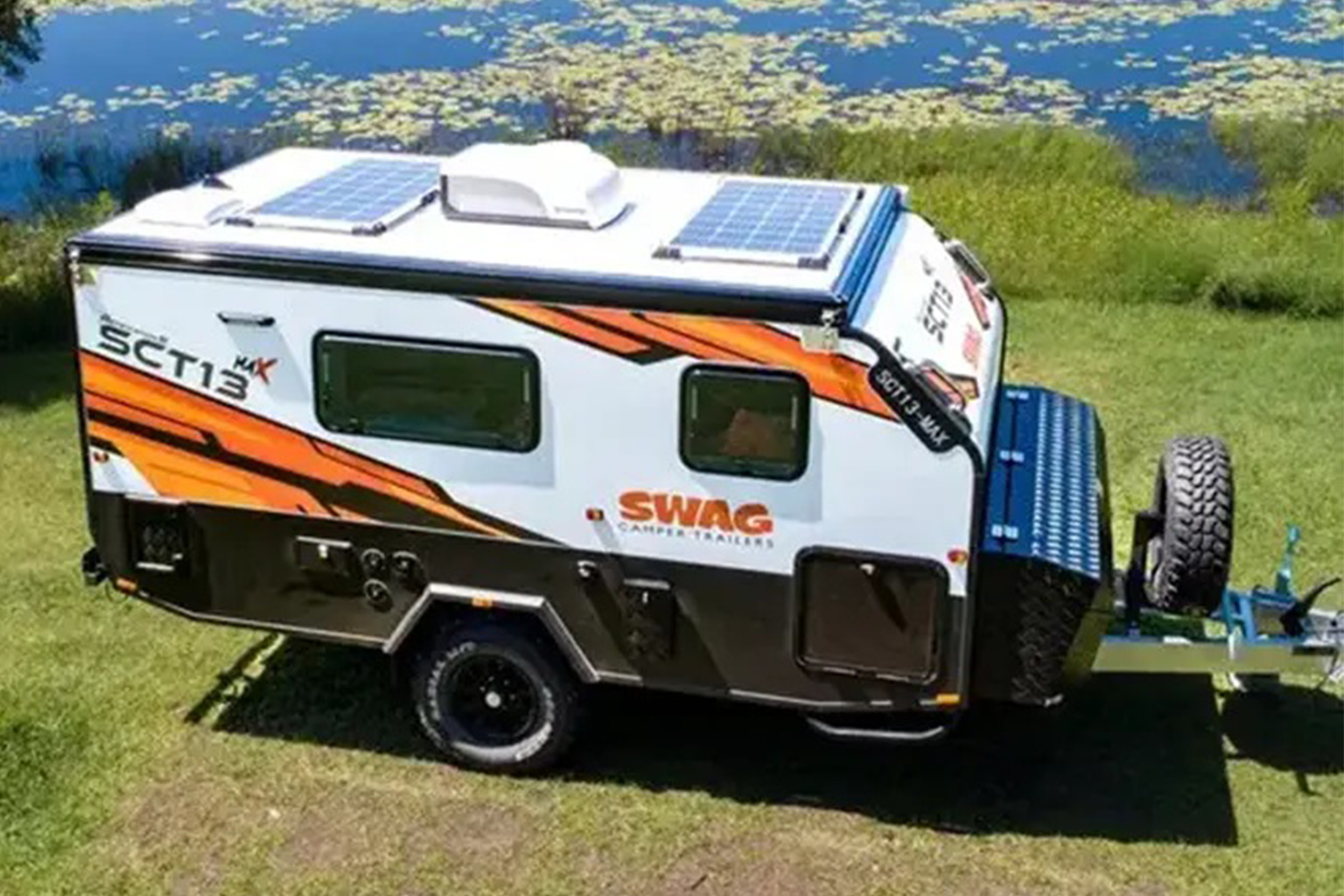
If you are asking what size solar panel do I need for my caravan, the short answer for most Australian vans is between 200W and 400W.
A couple running a fridge, lights and a few devices for a weekend off-grid will usually be comfortable on 200W to 300W.
Longer trips, bigger fridges and an inverter push that closer to 400W or more.
That range is a starting point, not a specification.
The real answer depends on three things:
- How much power you use in a day
- How much sun you actually get
- How much battery you have to store it
This guide walks through the calculation, then explains why two reputable sources can give you two very different numbers for the same van.
The Short Answer, by How You Travel
| How you travel | Typical daily use | Solar to aim for |
|---|---|---|
| Powered sites, occasional free camp | Lights, phone charging, small fridge | 100W to 150W |
| Weekends off-grid, couple | Fridge, lights, water pump, devices | 200W to 300W |
| Extended off-grid touring | Fridge, inverter, laptops, fans | 300W to 400W |
| Family van, longer trips | Larger fridge, more devices, more lights | 400W to 600W |
If you want a number you can act on today, use the table. If you want a number you can trust, do the calculation below. It takes about ten minutes.
Working Out What Size Solar Panel You Need for Your Caravan
Step 1: Add up what you use in a day
Every 12V appliance draws a current measured in amps.
Multiply the amps by the hours you run it, and you get amp-hours (Ah).
Add those together for a daily total.
A realistic day in a hybrid caravan might look like this:
- 75L compressor fridge: around 45 Ah
- LED lights, 0.5A for 5 hours: 2.5 Ah
- Water pump, short bursts: 1 Ah
- Roof and cabin fans, 2A for 6 hours: 12 Ah
- Phone and laptop charging: 5 Ah
- TV, 4A for 2 hours: 8 Ah
Daily total: roughly 75 Ah.
The fridge is doing most of the work here, and that is normal. In summer heat, it can account for over half your daily draw.
Step 2: Convert amp-hours to watt-hours
Multiply your daily amp-hours by your battery voltage.
A lithium system sits around 12.8V.
75 Ah x 12.8V = 960 watt-hours per day
Step 3: Divide by realistic sunlight hours
This is the step that decides your answer, and it is the one most guides rush.
960 Wh divided by 5 hours of good sun = 192W
960 Wh divided by 3.5 hours of weaker winter sun = 274W
Same van.
Same fridge. An 80W difference, purely from the assumption.
Step 4: Add a buffer
Panels rarely produce their rated output.
Heat, dust, shading, panel angle and cable losses all take a cut.
Adding 20% to 25% covers it.
192W plus 25% = 240W
274W plus 25% = 343W
So for this van, 300W to 400W is the sensible target.
Enough to cope with a flat grey day, without carrying panels you never use.
Why Two Guides Give You Two Different Answers
Search for the right size solar panel for a caravan and you will find Australian guides recommending anything from around 150W to 500W for what looks like a similar setup.
The difference often comes down to how much usable sunlight each guide assumes the solar panels will receive each day.
One guide might calculate its recommendation using six peak sun hours per day. Another might use three and a half.
With fewer peak sun hours available, you need more solar capacity to generate the same amount of power.
Peak sun hours are also different from daylight hours.
They represent the number of hours per day when the sun’s energy is equivalent to full-strength solar irradiance.
That figure changes depending on your location, the season and weather conditions.
This means the same caravan can have very different solar requirements depending on where and when you travel.
A setup that performs comfortably in far north Queensland in October may generate considerably less power in Victoria during June.
The Bureau of Meteorology publishes data on average daily solar exposure across Australia.
Checking the conditions for the regions and seasons you actually travel through gives you a much better starting point than relying on one generic sunlight assumption.
Your Battery Matters as Much as Your Panels
Solar panels generate power, but your battery determines how much of that power you can store and use later.
That means there is little value in fitting a large solar array if your battery bank is too small to store the extra energy.
As a rough guide, aim for around 1W to 1.5W of solar for every amp-hour of lithium battery capacity.
A 300Ah lithium bank, for example, will often suit around 300W to 450W of solar.
Battery type also changes the calculation.
A 200Ah AGM battery may only provide around 100Ah of usable capacity, while lithium batteries let you use a much larger share of their rated capacity.
Your charge controller also affects how much energy reaches the battery.
An MPPT controller generally gets more from the same solar panels than an older PWM controller, particularly in cooler or overcast conditions.
Fixed, Portable or Flexible Panels
Fixed monocrystalline panels mount to the roof and work without you thinking about them.
They are the most durable option and the best value per watt.
The trade-off is that they only generate where you park.
Portable folding panels and blankets can be angled at the sun and moved into a clear patch while the van sits in shade.
Many travellers run both, with fixed panels as the baseline and a portable panel for difficult sites.
Flexible panels are light and sit flush, which suits curved roofs.
They generally have a shorter working life than rigid panels because they run hotter against the roof surface.
Roof space is the usual limit.
A compact pop-top might fit one or two panels.
A larger van will take three.
Weight is worth a thought as well, and if you are close to your limits, our guide to caravan weights is a good place to start.
Check What Is Already Fitted Before You Add Anything
Most solar guides assume you are retrofitting an older van.
If you are shopping for a new off-road caravan, the more useful question is whether the factory system already covers you.
Modern off-grid caravans are specified around several days of independent power rather than an overnight stop.
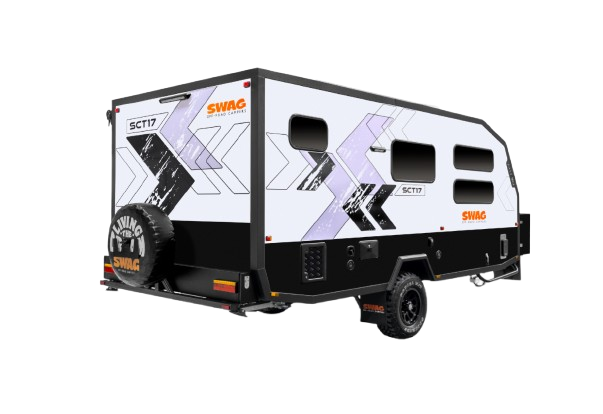
The SCT17, for example, is built with a 400W roof-mounted solar array, a 300Ah Australian-made lithium battery, an MPPT controller, a DC-DC charger for topping up while you tow, and a 2000W inverter for 240V appliances.
Run that against the calculation above.
A 75 Ah daily draw against 400W of solar and 300Ah of storage leaves genuine headroom for a run of overcast days.
That is the check worth doing before you spend anything: work out your daily figure, compare it against what the van already carries, and only then decide whether you need more.
A note on expectations.
Solar of this size comfortably runs a fridge, lights, fans, water pump and device charging.
It will not run a rooftop air conditioner for any meaningful length of time.
Air conditioning on 240V needs mains power or a generator, whatever your panels are rated at.
Talk to the Team at SWAG Off-Road Campers
Working out what size solar panel you need for your caravan comes down to one honest number: how much power you use in a day.
Once you have that, everything else follows.
If you are comparing vans and want to know whether a factory system suits how you travel, our team can walk you through the power setup model by model.
Come and see a van at your local showroom, or get in touch with the team and tell us how you like to camp.